The system of record is not the system of work
Every supply chain runs two IT landscapes. Only one of them appears on the architecture slide, and it is not the one making today's decisions.
Twenty years moving physical goods across more than eighty countries. Consumer goods, medical devices, building materials, coffee. Six M&A integrations, CHF 850m of spend under management, and one finding that survived every industry change. The most important application in every operation I have entered was a spreadsheet nobody sanctioned.
Companies spend millions on enterprise systems. Then their planners rebuild the supply chain in Excel.
This is not a failure story. It is the starting point of this book, and it deserves a precise statement.
Every supply chain runs on two IT landscapes - the sanctioned one that records what happened, and the unsanctioned one that decides what happens next.
The first landscape has a budget, a steering committee, and an architecture diagram. The second has neither budget nor diagram. It has something better. It works by Tuesday.
1.1The two landscapes
Walk into any trading floor, mill, or distribution centre and ask for the systems map. You will get the familiar acronyms. ERP for transactions and finance. APS for planning. TMS for freight. WMS for the warehouse. Perhaps a control tower on top, stitching the views together.
These systems earn their licence fees. They hold the ledger, enforce the process, satisfy the auditor. I have implemented them, integrated them, and defended their budgets. Nothing in this book argues against them.
Now stand next to a planner at 08:30.
A vessel skipped a port call overnight. A buyer changed the blend. Quality flagged two lots at origin. None of this fits the screens the sanctioned landscape provides. So the planner does what planners have done since 1995: exports to Excel, joins three reports that were never designed to meet, and produces the one artifact everyone will actually use today - the plan.
The ERP holds the truth. The workbook holds the decision.
The system of record is not the system of work.
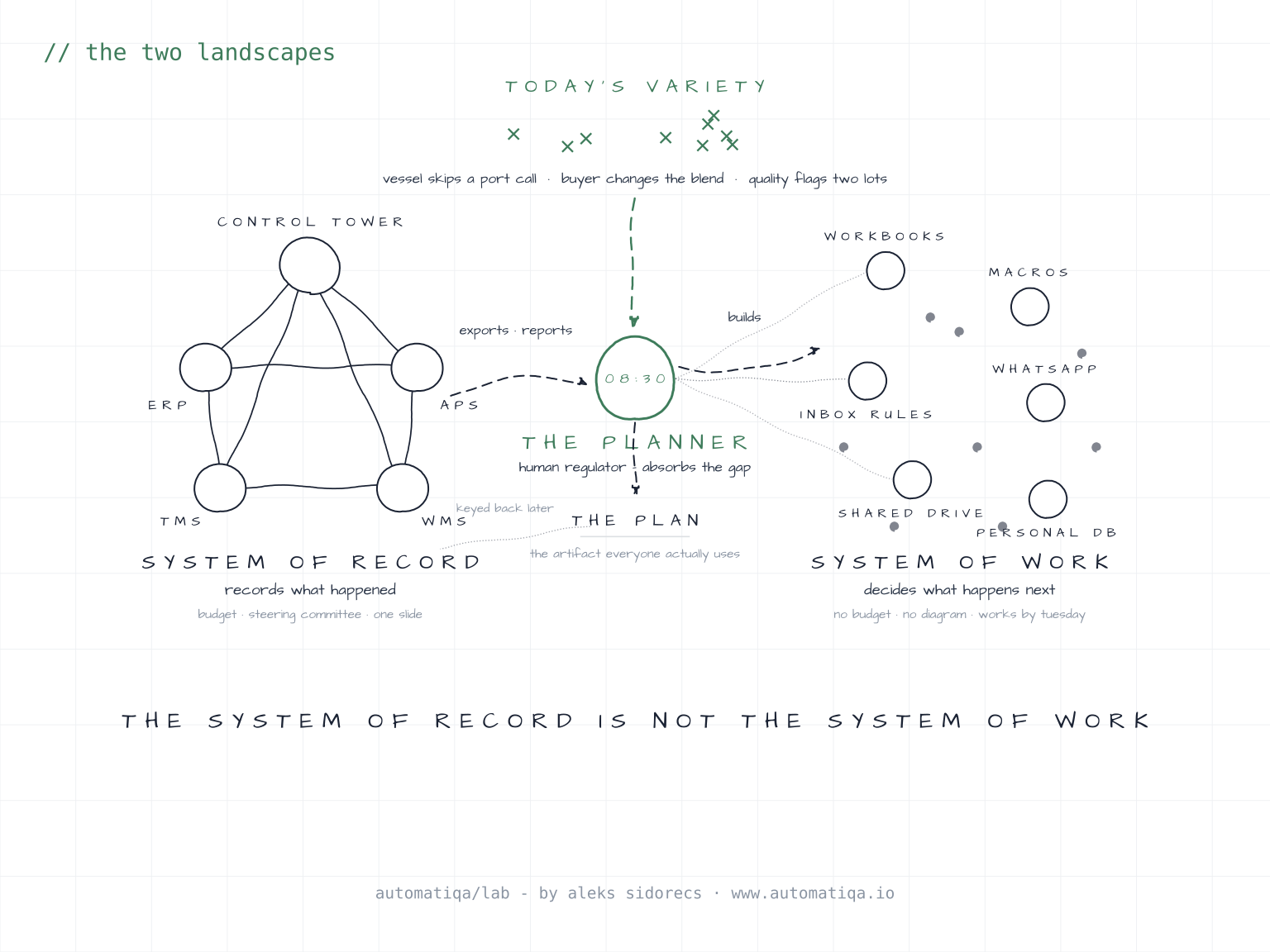
Figure 1.1 - The two landscapes. By Aleks Sidorecs.
1.2How big is the second landscape
Nobody budgets for it, so nobody measures it.
In a recent mapping exercise, several hundred supply chain workflows were charted from level 1 down to level 3 - allocation, execution, documentation, claims, the lot. The systems diagram of the same operation fits on a single slide. The workflow map does not.
Every workflow that appears on the map but not on the slide lives somewhere. A workbook. A macro. A shared drive. An inbox rule. A personal database that has outlived three system upgrades and two changes of management.
IT departments call this shadow IT. The term does useful work in a security review and no work at all in an operating review. Shadow implies an exception. In most supply chain functions I have seen, this is the operating model.
1.3Why IT cannot close the gap
The reflex is to blame the IT department. Resist it.
Consider the arithmetic an IT leader faces. Most of the budget goes to keeping the first landscape alive - licences, upgrades, integrations, security, audits. What remains funds change, and change requests arrive from every function, not just yours. Your planner's Tuesday problem competes with finance's close, legal's retention policy, and a cyber insurer's new questionnaire.
Then a deal closes. I have lived through six M&A integrations, from consumer brands to a CHF 30 billion merger. Each one doubles the landscape overnight and resets the roadmap for years.
The backlog is not a failure of discipline. It is arithmetic.
No supply chain professional has ever resigned because the ERP was too good. Plenty have resigned over the workaround they were forced to maintain around it.
1.4The wrong question
For years, executives asked me some version of the same thing: how do we get our people off the spreadsheets?
Wrong question. The right one is why the spreadsheet keeps winning - against every system we buy.
The answer is older than ERP.
1.5The law the spreadsheet obeys
In 1956, the cybernetician W. Ross Ashby formulated the Law of Requisite Variety: only variety can absorb variety.1 A regulator must carry at least as many possible responses as the disturbances its environment produces. Otherwise the disturbance wins.
A supply chain is a machine for absorbing disturbance. Strikes, monsoons, a skipped port call, a certificate that expires mid-voyage, a buyer's change of heart. The variety arriving at a planner's desk on any given morning is enormous. The sanctioned landscape encodes only the variety its designers anticipated at blueprint time, frozen at the last release.
The planner meets today's variety with yesterday's system. The gap between them must be absorbed somewhere.
It is absorbed in Excel.
The spreadsheet is not a bad habit. It is a control response - the cheapest, fastest way a human regulator adds the missing variety back into the machine. Ban it, and the variety does not disappear. It moves to WhatsApp.
This is why two decades of Excel-elimination programmes have eliminated approximately nothing. You cannot delete the second landscape. You can only decide whether it stays invisible.
1.6What changed
The gap is old. The tools are new.
For most of my career, the second landscape had one building material - the spreadsheet, with the occasional personal database for the brave. What a planner could build alone was capped by what one workbook could hold.
That cap is gone. Drag-and-drop app builders, workflow automation platforms, and now AI assistants have moved software-building down the skill curve - far enough that the person who owns the problem can ship a working tool to thirty colleagues before the ticket clears triage. The industry calls these people citizen developers. Gartner coined the term in 2009,2 and the fundamentals have held since: the tools are real, the builders are subject-matter experts rather than coders, and the movement is not a fad.
None of this is new, and I want to be precise about what this book adds. The generalist case has been made. The domain treatment has not - and supply chain is not just another function adopting low-code. It is the function with the widest variety gap in the enterprise, the deepest spreadsheet culture, the most dangerous data, and the most to gain. A citizen developer in marketing builds a campaign tracker. A citizen developer in supply chain touches physical goods, contracts, and customs declarations. The stakes are different. The playbook must be too.
I have built my share of the second landscape myself - macros, databases, apps, and lately agents. Some of it still runs. Some of it should not. Both facts shaped this book.
1.7Three ways forward
Strip away the vendor decks and an operations leader has three options.
- Wait. Ask the organization to be patient until the roadmap delivers. The arithmetic above says the wait is structural, not temporary.
- Outsource. Hire consultants or a development shop for every gap. This works for the big blocks. But the variety does not stop arriving after handover, and no retainer covers Tuesday morning.
- Build where the problem lives. Accept that your planners, coordinators, and quality managers already build the second landscape - and give them tools, guardrails, and recognition instead of a ban they will ignore.
This book is about the third option - not because it is fashionable, but because it is already happening in your operation, today, unsanctioned and ungoverned. The only open question is whether it compounds or corrodes.
1.8What this book is not
Let me kill one expectation now. No citizen developer will rebuild your ERP, your APS, or a customs filing system, and anyone selling that vision should be walked to the door. The territory in this book is the glue: the space between systems where the variety leaks and the spreadsheets breed. That territory is narrower than the vendors claim and larger than your systems diagram admits.
The next chapter maps it properly.
Stop asking how to get your people off spreadsheets. Start asking what they have been building all along.
1.9Chapter summary
- Every supply chain runs two IT landscapes: the sanctioned system of record and the unsanctioned system of work. Only the first appears on the architecture slide.
- The gap between them is structural. Ashby's Law of Requisite Variety predicts it: the spreadsheet is a control response, not a bad habit.
- IT cannot close the gap. Run costs, integration burden, and M&A resets consume the change budget. The backlog is arithmetic.
- New tools have moved building down the skill curve. The people who own the problems can now build real applications - and already do.
- The choice is not whether supply chain people build software. It is whether the organization sees it, governs it, and compounds it.
-
W. Ross Ashby, An Introduction to Cybernetics, 1956. In Ashby's own phrasing: "only variety can destroy variety." ↩
-
Ian Finley coined "citizen developer" in a 2009 Gartner report on end-user application development. The persona framing - a role attribute, not a job title - is Gartner's and holds up. ↩